
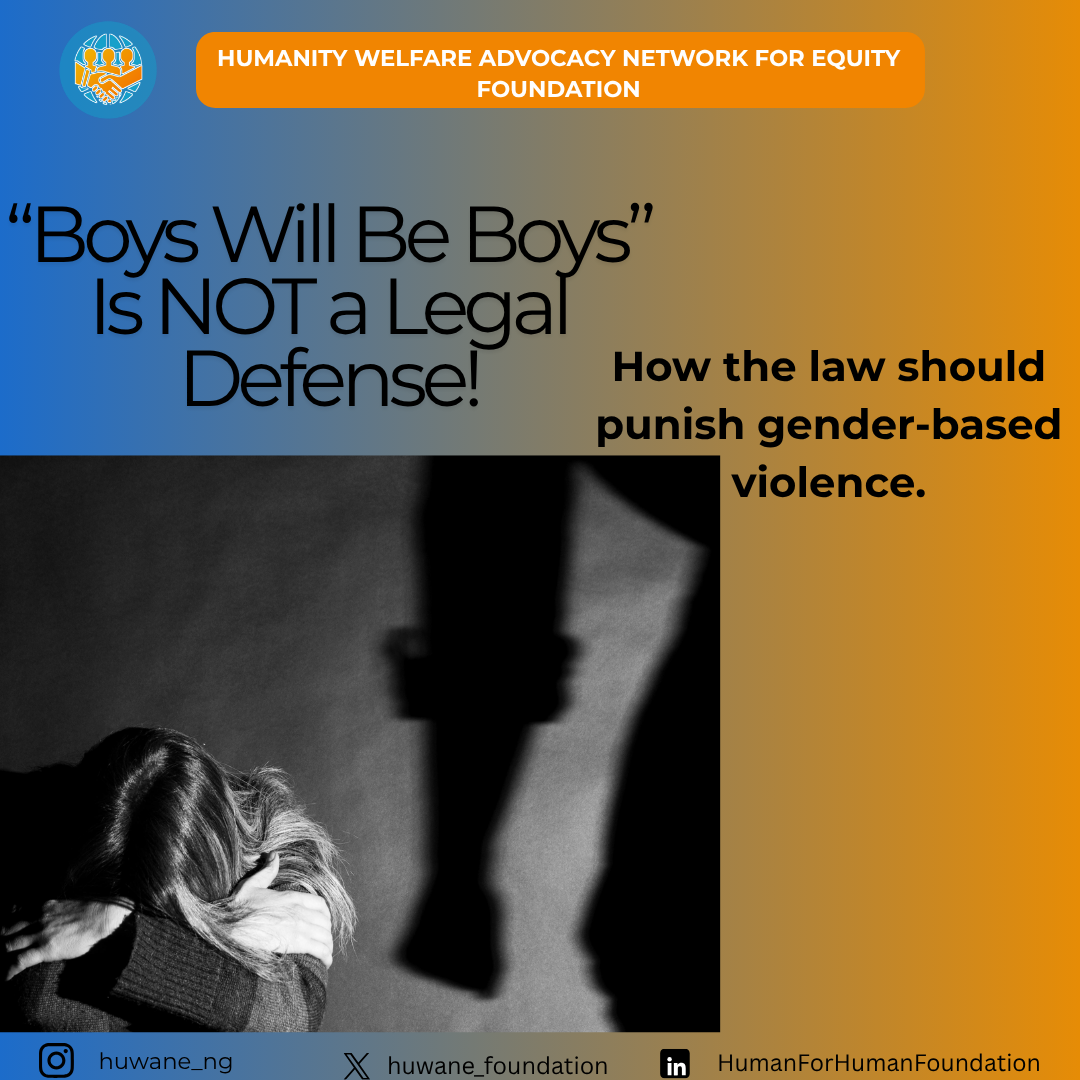

The phrase Boys Will Be Boys is a long-standing idiom that suggests boys or men naturally behave in rough, noisy, or sometimes aggressive ways, and that such behaviour should be expected and excused as part of their inherent nature. Originating from a Latin proverb dating back to at least the 16th century sunt pueri pueri, pueri puerilia tractant meaning boys are boys, and boys do childish things the phrase has been historically used to dismiss or minimize the misbehaviour of boys as natural, inevitable or harmless. The phrase ‘Boys Will Be Boys’ is a culturally entrenched expression used to excuse or downplay male misconduct, especially aggressive or violent behaviour. In Nigeria, where patriarchal norms dominate, this phrase dangerously normalizes gender-based violence (GBV) by implying that male aggression is ‘natural’, ‘inevitable’ and should be considered a nom for which they should not be punished or the punishment mitigated. This mindset not only invalidates the experiences of survivors but also fosters a culture of impunity, where perpetrators evade accountability and victims are silenced or blamed. Such normalization perpetuates cycles of violence and obstructs justice, undermining efforts to create a safe and equitable society.
In legal contexts, this mindset is particularly dangerous because it normalizes harmful or violent behaviour by males, often leading to leniency or outright dismissal of serious offenses such as gender-based violence (GBV). When courts, law enforcement, or society accept the idea that Boys Will Be Boys as a defence, it undermines accountability, perpetuates gender inequality, and denies justice to victims. This mindset also reinforces toxic masculinity by suggesting that aggression and dominance are natural male traits that cannot or should not be controlled.
This phrase has been repeatedly used in Nigeria to excuse acts ranging from domestic violence to sexual harassment and assault. For example, many victims of intimate partner violence report that their abusers, often husbands or boyfriends, are excused by families and communities with the rationale that men cannot help themselves or are simply being boys. A recent mixed-methods study found that while a majority reject wife-beating, nearly 39% of respondents still believe some forms of violence should be handled privately rather than legally reflection of cultural conditioning that silences victims and protects perpetrators. The consequences are severe. Victims face physical injuries, psychological trauma, and social stigma, often compounded by victim-blaming attitudes in media and society. This mindset also discourages victims from seeking help, as many fear being ostracized or disbelieved. The societal cost is profound: GBV undermines social cohesion, economic productivity, and public health, with studies showing that over 70% of Nigerian women have experienced some form of GBV, mostly perpetrated by intimate partners.
Examples to Illustrate
– In some cases of domestic violence or harassment, perpetrators have been excused by family or community members with the phrase, leading to victims not getting justice. For example, in a rape case, the perpetrators may be excused and the victim may even be blamed with the defence that Boys Will Be Boys and what was the victim expecting dressing in a certain matter.
– In schools, boys who bully or harass girls are sometimes excused with boys will be boys, which prevents proper discipline and protection for victims.
– In Nigeria and many other countries, high rates of intimate partner violence are linked to cultural acceptance of male aggression and dominance.
The phrase perpetuates harmful gender stereotypes by implying that boys and men are inherently aggressive, uncontrollable, and excusable for misconduct. This biological essentialism supports the idea that male violence and dominance are natural and inevitable, which is a core component of toxic masculinity narrow, repressive definition of manhood tied to violence, dominance, and emotional suppression. This ‘biological’ excuse and defence has been greatly flawed by Neuroscientific research that shows that boys and girls brains are more alike than different, debunking the idea that boys are biologically wired to be aggressive. Such stereotypes contribute to a culture where gender-based violence is normalized and tolerated. When society expects boys to be aggressive, behaviours like bullying, harassment, and even sexual violence are often minimized or ignored. This mindset also limits a boys’ emotional development by discouraging empathy, vulnerability, and accountability.
Legal Standards and Gender-Based Violence in Nigeria
Legally, gender-based violence (GBV) is addressed through a combination of criminal laws, protective statutes, and international human rights obligations. Nigeria has made legislative strides to combat GBV, notably through the Violence Against Persons (Prohibition) Act (VAPP) of 2015, which criminalizes physical, sexual, psychological, and economic violence. The Act prescribes penalties including imprisonment and fines, and provides for protection orders and victim support services. However, the VAPP Act impact is limited because it only applies in the Federal Capital Territory and a few states, leaving large parts of the country without comprehensive legal protection. Moreover, enforcement remains weak due to institutional biases, inadequate training, and cultural myths that influence police, prosecutors, and judges. For instance, despite thousands of reported cases, conviction rates remain dismally low. The media also often perpetuates patriarchal narratives, sometimes blaming victims or minimizing the severity of violence, which further hinders justice. In higher education institutions, where GBV is rampant, many perpetrators often lecturers or male colleagues face little or no consequences, reflecting systemic impunity.
Why Boys Will Be Boys Is Not a Legal Defence
The law must uphold equality, justice, and human rights, treating all individuals regardless of gender equally before the law. The defence of Boys Will Be Boys is antithetical to these principles because it:
– Excuses criminal behaviour based on gender stereotypes, undermining the rule of law.
– Perpetuates discrimination and violence by allowing male perpetrators to evade responsibility.
– Violates constitutional guarantees of dignity and protection for all citizens.
– Contradicts Nigeria international obligations under treaties like the Convention on the Elimination of All Forms of Discrimination Against Women (CEDAW).
Courts must reject cultural excuses and apply the law rigorously, ensuring perpetrators are held accountable. Legal systems worldwide emphasize that cultural norms cannot justify violations of fundamental rights. Nigerian courts, too, have a duty to uphold this standard to protect victims and deter future violence.
How should the Law Should Respond??
Legal Reforms:
- Nationwide Adoption of the Violence Against Persons (Prohibition) Act: Urgently domesticate and enforce the VAPP Act across all Nigerian states to guarantee uniform protection.
- Specialized Training for Law Enforcement and Judiciary: Equip police, prosecutors, and judges with gender-sensitive training to handle GBV cases without bias or delay.
- Strengthen Victim Support Services: Expand access to medical, psychological, and legal aid, including the establishment of more sexual assault referral centres.
- Establish Accountability Mechanisms: Create independent bodies to monitor GBV case handling and ensure transparency and justice.
Cultural and Educational Interventions:
- Public Awareness Campaigns: Use media and community outreach to dismantle harmful myths like Boys Will Be Boys, emphasizing that violence is a choice and punishable offense.
- School Curriculum Reform: Integrate gender equality and GBV prevention education from early schooling to reshape attitudes.
- Engage Community and Religious Leaders: Partner with influential leaders to promote gender equity and support survivors, challenging patriarchal norms.
- Media Ethics and Reporting: Encourage responsible, survivor-centered journalism that avoids victim-blaming and highlights accountability[2][4].
Addressing Counterarguments
Some claim that cultural traditions should be respected or that men are also victims of violence. While cultural sensitivity is important, traditions must evolve to protect human rights and dignity. Accepting Boys Will Be Boys as a defence perpetuates harm and inequality. Supporting all victims, regardless of gender, requires rejecting excuses that normalize violence. Also, the defence that Boys Will Be Boys is biological is fundamentally flawed by evidence from Neuroscientific research that shows that boys and girls brains are more alike than different, debunking the idea that boys are biologically wired to be aggressive
Conclusion
The phrase Boys Will Be Boys is an invalid and dangerous excuse for gender-based violence in Nigeria. It perpetuates a culture of impunity, silences victims, and obstructs justice. Nigeria legal framework, while promising, requires urgent reform and enforcement to protect all citizens equally. Cultural attitudes must shift through education and public engagement to reject harmful stereotypes and promote accountability.
Call to Action:
I humbly submit that the society is simply a mirror of its most fundamental unit, the family. Before any real change can be effected it has to have been effected from homes. As the society is simply a congregation of individuals from different families.
The next logical step is for the government to ensure the VAPP Act is adopted nationwide and enforce strict penalties for GBV. Educators and community leaders should lead efforts to dismantle patriarchal norms. The media must report ethically and amplify survivor voices. Above all, every Nigerian must reject the myth that violence is just boys being boys and demand justice for survivors. Only through combined legal reform and cultural change can Nigeria break the cycle of gender-based violence and build a safer, more equitable society.
References:
[1] Public attitudes and perceptions towards GBV in Nigeria, Bristol University Press, 2025
[2] Media representation of GBV in Nigeria, Mediterranean Publications, 2025
[3] Role of African Traditional Religion in promoting GBV, MDPI, 2025
[4] Communication in GBV prevention in Nigeria, Saudi Journals, 2025
[5] GBV responses and reporting in Adamawa State, Texila Journal, 2025
[6] GBV in Nigerian Higher Education, JBReview, 2025
0 Comments