
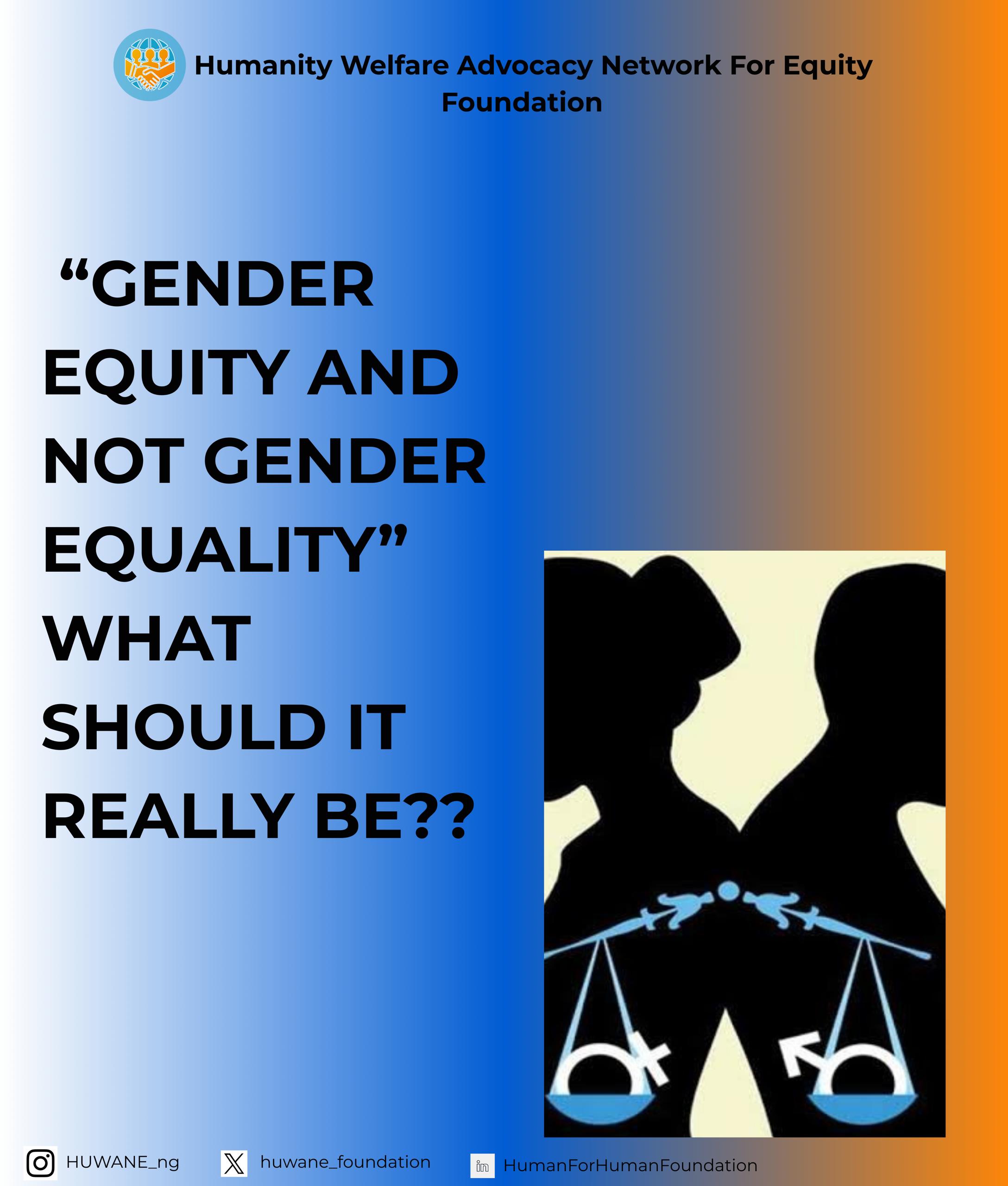

DEFINITIONS
Equity refers to fairness and justice in resource allocation, opportunities, and outcomes. It recognizes that individuals or groups do not start from the same place due to historical, systemic, or social disadvantages. Equity involves providing tailored support based on unique circumstances to ensure everyone achieves equal outcomes.
Equality refers to treating everyone the same by providing identical opportunities, rights, and resources. It assumes a level playing field for all individuals, regardless of their starting point or circumstances. Equality aims for uniform treatment but does not account for disparities that may prevent some people from benefiting equally from the same resources.
Gender refers to the socially constructed roles, responsibilities, and opportunities associated with being male or female in a given society. It recognizes that these roles are not biologically determined but rather shaped by cultural, historical, and social factors.
INTRODUCTION
Gender equality and gender equity are two interconnected but distinct concepts that play a critical role in addressing gender disparities in society. Gender Equality refers to the state in which individuals, regardless of their gender, have equal access to opportunities, resources, rights, and responsibilities. It assumes that all genders are treated the same without considering the historical and systemic barriers that might prevent certain groups from achieving equal outcomes. Gender Equity, on the other hand, focuses on fairness by recognizing that different genders face unique challenges due to historical, cultural, and systemic inequalities. It involves implementing measures that address these specific needs to ensure everyone has an equal chance to succeed. Equity acknowledges that treating everyone the same (equality) does not necessarily lead to fairness or justice. For instance, offering maternity leave for women or creating mentorship programs for women in male-dominated fields are examples of equity-based solutions. Gender equity should be seen as a means to achieve gender equality. Without equity, equality becomes superficial because it fails to address the root causes of inequality.
The distinction between gender equality and gender equity matters because treating everyone equally without accounting for their unique circumstances can perpetuate inequality rather than resolve it. Equity ensures that systemic disadvantages are addressed so that true equality becomes possible. Gender equity is essential because treating everyone the same (equality) doesn’t solve deeper problems caused by unfair systems. Imagine two people trying to look over a fence to watch a football game. One is tall, and the other is short. If you give both of them the same-sized stool (equality), the tall person can see over the fence easily, but the short person still struggles. However, if you give the short person a taller stool (equity), both can now see over the fence comfortably. This is the difference between equality and equity. Also imagine giving everyone the same-sized bike to ride. While this might seem fair (equality), it doesn’t help if some people are too short or too tall to use that bike comfortably. What they need is a bike that fits their size (equity). Similarly, treating everyone equally at work or school doesn’t fix problems like discrimination or unequal access to resources. Illustrative Example: Imagine three people of different heights trying to pick apples from a tree:
Equality: All three are given the same ladder of equal height. While this seems fair, only the tallest person can reach the apples because the ladder doesn’t account for their height differences.
Equity: Each person is given a ladder adjusted to their height so that all three can reach the apples equally. This approach ensures fairness by addressing their individual needs.
Equity as a Pathway to Equality
Gender equity is widely recognized as the most effective pathway to achieving true gender equality. While gender equality aims to provide equal opportunities and treatment for all genders, equity focuses on addressing systemic barriers, obstacles and historical disadvantages that prevent marginalized groups from fully participating in society. Equity ensures fairness by providing tailored solutions that enable all individuals to achieve similar outcomes, regardless of their starting point. Think of equity as the bridge that helps us reach equality. Equality is the goal; where everyone has the same opportunities but we can’t get there without first addressing the unfair barriers that hold some people back. Equity means giving people what they need to succeed based on their unique circumstances.
Unlike equality, gender equity recognizes that men and women have different biological, social, and economic realities. Instead of treating them the same, gender equity focuses on fairness by addressing their specific needs and circumstances. Many people assume that gender equality and gender equity are the same, but they serve different purposes and should be applied in different contexts. A clear example of gender equity can be seen in professional football. While both men and women play the sport, they do not generate the same amount of revenue. The men’s game attracts significantly larger audiences and sponsorship deals, leading to higher earnings. This is why the difference in their paychecks is a matter of equity rather than inequality; since wages in professional sports are largely based on revenue generation. Additionally, an interesting case that highlights the difference in physical capabilities is when a women’s football team played against a group of 17-year-old boys and was soundly defeated. This demonstrates that, in certain areas, expecting the same treatment for men and women may not be practical or fair. Alo, if a man and a woman are both accountants performing work of equal value, then gender equity demands that they receive the same salary and opportunities, as their contributions to the workplace are identical.
Examples of How Equity Can Lead to Equality
- Workplace:
– Equality: Offering equal training programs to all employees.
– Equity: Creating leadership training programs specifically for women in male-dominated industries, helping them overcome systemic barriers and advance into leadership roles.
– Outcome: Over time, more women achieve leadership positions, leading to gender balance in management.
- Education:
– Equality: Providing equal access to STEM classes for boys and girls.
– Equity: Offering scholarships, mentorships, and outreach programs specifically designed to encourage girls to pursue STEM careers.
– Outcome: More women enter STEM fields, closing gender gaps in science and technology professions.
- Healthcare:
– Equality: Providing equal access to healthcare services for all genders.
– Equity: Offering maternal health services and subsidized reproductive healthcare for women who face unique health challenges.
– Outcome: Improved health outcomes for women lead to healthier families and communities.
Broader Implications/ Effects/ Benefits of Gender Equity
The broader implications of gender equity extend far beyond individual benefits, impacting societal structures, economic systems, and global development goals. By addressing systemic barriers and promoting fairness, gender equity contributes to sustainable development, enhances economic growth, fosters social cohesion, and supports the achievement of global goals like the Sustainable Development Goals (SDGs). Gender equity increases women’s participation in the workforce, leading to higher productivity and economic growth. Studies show that closing the gender employment gap could boost GDP significantly in many countries. Also, by promoting fairness and reducing disparities, gender equity helps build more inclusive societies where all genders feel valued and respected. Gender equity is crucial for achieving SDG 5 (Gender Equality) and contributes to other goals like SDG 8 (Decent Work and Economic Growth) and SDG 10 (Reduced Inequalities). Gender equity has far-reaching benefits that affect not just individuals but entire societies and economies. It helps create a more balanced and fairer world where everyone can contribute and thrive. For example: Rwanda’s approach to gender equity demonstrates how targeted measures can lead to gender equality and equal gender representation, particularly in governance. By leveraging equity-based policies, Rwanda has achieved one of the highest rates of female representation in government globally, with women holding 61% of parliamentary seats and 52% of cabinet positions. By prioritizing gender equity, Rwanda has not only achieved equal representation but also demonstrated how fairness-based policies can drive long-term societal transformation
Benefits
- Economic Benefits:
– Companies with diverse leadership (including women) tend to perform better financially and innovate more.
– Closing the gender pay gap can increase consumer spending and boost economic growth.
- Social Benefits:
– Gender equity reduces violence against women by challenging harmful stereotypes and empowering women economically.
– It fosters more inclusive communities where diverse perspectives are valued, leading to better decision-making.
- Global Development:
– Gender equity is essential for achieving Sustainable Development Goal 5 (Gender Equality) and contributes to other SDGs like SDG 8 (Decent Work and Economic Growth) and SDG 10 (Reduced Inequalities).
– Women’s participation in agriculture can improve food security and reduce poverty in developing countries.
Counterarguments
Despite the compelling case for gender equity, several counterarguments arise. Some critics argue that focusing on equity might reinforce stereotypes or create perceived favoritism, while others suggest that equity measures could be overly burdensome or inefficient. However, these concerns can be addressed by understanding the nuances of equity and its implementation. So opposing arguments include:
– Reinforcing Stereotypes: Critics argue that equity measures might reinforce stereotypes by treating women differently. However, equity aims to address systemic barriers that prevent women from succeeding on an equal footing, not to perpetuate stereotypes.
– Perceived Favoritism: Some argue that equity measures could be seen as favoring certain groups over others. Yet, equity seeks to level the playing field by providing support where it is needed most, ensuring fairness rather than favoritism.
– Efficiency Concerns: Implementing equity measures might seem complex or costly. However, the long-term benefits of equity, such as increased productivity and diversity, outweigh these costs.
Addressing Counterarguments
- Reinforcing Stereotypes:
– Response : Equity measures are designed to address systemic barriers, not reinforce stereotypes. For instance, providing childcare support helps women balance work and family responsibilities, enabling them to succeed in their careers.
- Perceived Favoritism:
– Response : Equity is about fairness, not favoritism. It provides support where needed to ensure equal opportunities.
- Efficiency Concerns:
– Response : The benefits of equity, such as increased diversity and productivity, outweigh the costs. Companies with diverse leadership tend to perform better financially.
Conclusion
The conclusion synthesizes the key points discussed in this work, emphasizing the importance of prioritizing gender equity as a pathway to achieving true gender equality. Gender equity is not merely a corrective measure but a transformative approach that addresses systemic barriers, obstacles, historical disadvantages, and societal norms that perpetuate inequality. By implementing equitable policies and practices, society can foster fairness, inclusivity, and sustainable progress across economic, social, and cultural domains. In essence, equity paves the way for true equality. The broader implications of gender equity underscore its importance as a transformative force in society. By promoting fairness, economic growth, social cohesion, and global development, gender equity creates a more just and prosperous world for all genders. It is essential for achieving sustainable development goals and fostering inclusive communities where everyone can thrive. While counterarguments to gender equity exist, they can be effectively addressed by understanding the purpose and benefits of equity. By recognizing that equity is about fairness and addressing systemic barriers, we can create a more inclusive and prosperous society for all. Equity measures are not about favoritism but about ensuring that everyone has a genuine chance to succeed. By understanding this distinction, we can better design policies and initiatives that create meaningful change for all genders.
Key Takeaways:
- Equity Leads to Equality: Equity addresses systemic barriers so everyone can compete on a level playing field.
- Broader Benefits: Gender equity improves economies, strengthens communities, and fosters sustainable development.
- Call to Action: Advocating for equitable policies is essential for creating a fairer society where all genders can thrive.
Call to Action
– Support policies that prioritize gender equity in workplaces, education systems, and healthcare.
– Challenge stereotypes and advocate for fairness in their communities.
– Recognize that achieving equality requires addressing systemic barriers through equitable measures.
References:
https://www.enterprise-development.org/weegateway/gender-equality-vs-equity/
https://www.fsg.org/blog/gender-equality-not-just-womens-issue/
https://www.unfpa.org/resources/frequently-asked-questions-about-gender-equality
https://iqeq.com/insights/why-we-need-gender-equity-not-just-equality/
https://www.weforum.org/agenda/2023/03/equity-equality-women-iwd/
https://www.goodwall.io/blog/gender-equality-vs-equity-vs-womens-empowerment/
https://en.wikipedia.org/wiki/Gender_equality
https://eige.europa.eu/publications-resources/thesaurus/terms/1262?language_content_entity=en
https://www.undp.org/rwanda/gender-equality-increased-productivity-and-sustainable-growth
https://www.undp.org/sites/g/files/zskgke326/files/migration/rw/RW_Gende-Equality-Strategy-2019-2022.pdf
https://www.imf.org/-/media/Files/Countries/ResRep/RWA/060717-gender-equality-and-macroeconomic-outcomes-in-rwanda.ashx
https://en.wikipedia.org/wiki/Gender_equality_in_Rwanda
https://www.imf.org/-/media/Files/Topics/Fiscal/Revenue-Portal/Gender/gender-equality-in-rwanda-and-in-the-rra.ashx
Educative, nice write up ✍️
Hmmmm. Was a good read 👍